2026
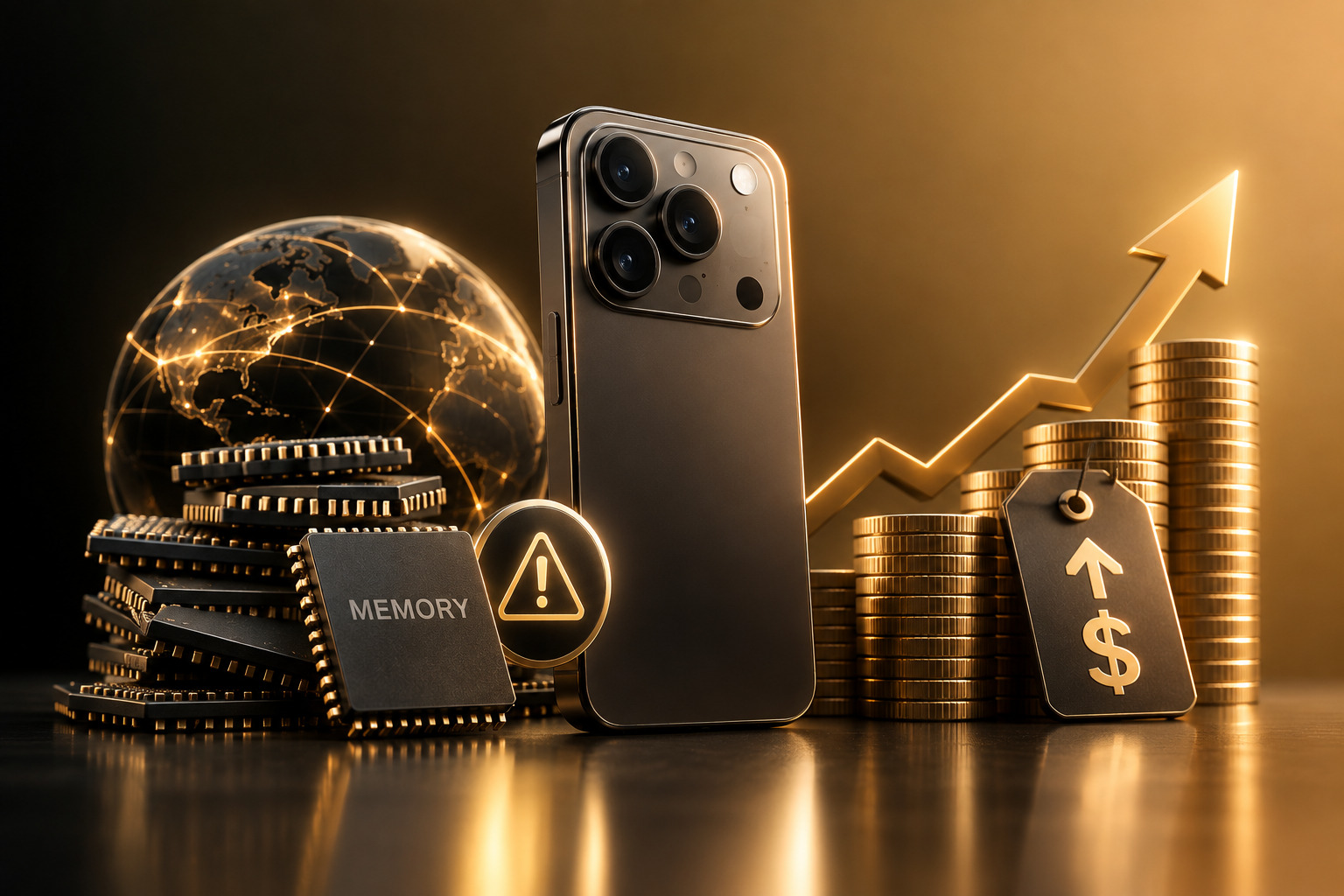
If buying a new phone feels noticeably more expensive this year, the numbers support that impression. Smartphone prices 2026 are being reshaped by an unusual component shortage that reaches far beyond the mobile industry. Memory—the RAM and storage every smartphone needs—has become considerably more expensive as semiconductor production increasingly serves the booming AI infrastructure market.
The effect is no longer theoretical.
Counterpoint Research’s September outlook projects the global smartphone average selling price at about $450 in 2026, up 22% year over year. At the same time, its August forecast expects global smartphone shipments to fall 14.3%.
That combination tells an important story. Consumers are not simply choosing more luxurious phones. Some of the cheapest parts of the smartphone market are shrinking, manufacturers are adjusting their portfolios, and buyers are keeping devices longer.
What’s Happening to the Smartphone Market in 2026?
The smartphone industry entered 2026 facing a problem that is difficult to solve with ordinary discounts or marketing.
Manufacturers need DRAM for working memory and NAND flash for storage. Those components compete for semiconductor manufacturing resources within a broader memory market experiencing extraordinary demand from AI infrastructure.
Counterpoint reported that smartphone memory prices rose more than 300% year over year in Q2 2026. It also found that memory costs had surpassed system-on-chip costs across smartphone price segments.
For manufacturers, that changes the economics of building a phone.
The result has included:
- Higher retail prices
- Reduced low-end product ranges
- Fewer inexpensive configurations
- Pressure on manufacturer margins
- Longer device replacement cycles
- Greater consumer interest in refurbished phones
Counterpoint now forecasts a 14.3% year-over-year decline in global smartphone shipments for 2026 and expects difficult conditions to continue into 2027.
Why Memory Has Suddenly Become So Expensive
Smartphones have always competed with PCs, servers and other electronics for semiconductor capacity. The AI infrastructure boom has dramatically increased that competition.
Large AI systems require enormous amounts of specialized high-bandwidth memory, or HBM, as well as server DRAM.
Memory manufacturers naturally have an incentive to allocate investment and manufacturing resources toward high-value products with strong demand.
That does not mean the exact memory inside a smartphone is simply being removed from a production line and placed in an AI server. Semiconductor supply chains are more complicated than that.
However, the industry’s priorities matter.
Counterpoint says the memory shortage has become the dominant pressure on the smartphone market and expects supply constraints to persist into the second half of 2027.
The smartphone industry therefore has limited ability to wait a few weeks and return to normal.
How the AI Boom Is Affecting Phone Components
There is an interesting contradiction in the 2026 market.
AI is simultaneously increasing demand for more capable smartphones and making some of the components needed to build those smartphones more expensive.
Consumers increasingly expect phones to handle:
- Generative AI features
- Advanced image processing
- On-device language models
- Real-time translation
- AI-assisted editing
- Personal assistants
Those functions benefit from capable processors and substantial memory.
Counterpoint found that shipments of smartphone processors supporting generative AI actually increased in the first half of 2026 even as overall smartphone SoC shipments declined.
In other words, the market is moving toward more computationally capable devices at the same time that component economics are squeezing the cheapest phones.
This helps explain why smartphone prices 2026 cannot be understood as ordinary inflation alone.
The structure of the market is changing.
Budget Phones Are Being Hit Differently From Flagships
A €50 increase matters very differently on a €150 phone than on a €1,200 flagship.
That is why the memory shortage is particularly painful for entry-level manufacturers.
Counterpoint estimates that the component cost of comparable low-end devices increased around 70% year over year by Q2, with memory responsible for almost all of that increase.
Manufacturers of inexpensive phones have fewer ways to absorb the extra cost.
They can:
- Increase the retail price.
- Reduce storage or other specifications.
- Keep older components in production.
- Remove low-margin models from the lineup.
- Reduce availability in less profitable markets.
All of these options affect consumers.
The US provides a striking example. Counterpoint reported that sales of smartphones below $100 fell 64% year over year in Q2 2026.
Premium manufacturers have more room to maneuver because component costs represent a smaller proportion of the final selling price. Their customers may also tolerate moderate price increases more easily.
That does not make flagships immune. It simply means the pressure is greatest at the bottom of the market.

Why Manufacturers Are Changing Their Product Strategies
For years, smartphone manufacturers competed by filling almost every conceivable price point.
The memory crisis makes that strategy harder to justify.
If a manufacturer earns very little on a budget model and its component cost suddenly rises, continuing to produce that model may make little commercial sense.
Counterpoint’s September forecast describes a “hollowing out” of the lowest new-device price bands. Some consumers trade up, some delay replacement, and others move toward refurbished or second-hand devices.
Manufacturers are responding by concentrating resources on models where margins remain sustainable.
We are also seeing changes to specifications.
Counterpoint reports that some manufacturers have responded to higher costs with lower storage capacities, simpler camera configurations and greater use of 4G devices in selected segments.
That means comparing 2026 phones by price alone can be misleading. A new device that costs the same as last year’s model may not necessarily provide the same relative specification level.
What Higher Smartphone Prices Mean for Consumers
The most important consequence of smartphone prices 2026 may be a change in how people think about ownership.
Longer Upgrade Cycles
If replacing a phone costs more, keeping an existing one for another year becomes more attractive.
Modern flagship and mid-range devices already offer enough performance for many users to keep them considerably longer than the traditional two-year upgrade cycle.
A battery replacement, software cleanup or carrier unlock may sometimes provide more practical value than immediately replacing an otherwise capable device.
Counterpoint says consumers are already responding to higher prices by delaying upgrades and considering refurbished alternatives.
Greater Importance of Device Value
The purchase price is only one part of smartphone value.
A device that remains usable across carriers, countries and ownership situations can provide greater long-term utility.
For example, an unlocked phone may be easier to:
- Move to a cheaper carrier
- Use with a local SIM while traveling
- Reassign to another family member
- Sell to a broader group of buyers
- Keep as an emergency spare
When replacing a smartphone becomes more expensive, getting maximum flexibility and useful life from the device you already own becomes increasingly valuable.
A relevant internal link here would be a guide to keeping your phone longer through carrier flexibility or an article explaining locked vs unlocked phones.
Premium vs Budget Purchasing Decisions
Higher component prices also complicate the traditional “buy cheap and replace sooner” approach.
A buyer may decide that paying more for a device with longer software support and stronger resale value makes sense if the phone will stay in use for four or five years.
Another buyer may find better value in a professionally refurbished previous-generation flagship.
Neither approach is universally correct.
Consumers should increasingly compare total ownership value rather than the launch-year specification sheet.
Refurbished Phones Could Become More Important
The secondary market is particularly interesting in this environment.
A two-year-old premium phone already exists; its manufacturing cost is no longer affected by today’s memory prices in the same way as a newly produced device.
That does not guarantee cheap refurbished phones. Increased demand can raise secondary-market prices too.
Still, the value equation becomes more attractive when new entry-level phones increase in price or disappear from certain segments.
Buyers considering used devices should verify:
- IMEI status
- Carrier lock status
- Battery condition
- Repair history where available
- Regional model
- Network compatibility
- Remaining software support
An internal link to a used-phone buying checklist would fit naturally here.
Could Smartphone Prices Fall Again?
Eventually, semiconductor supply adjusts.
Manufacturers expand capacity, demand patterns change, inventories normalize and new manufacturing processes enter production.
But consumers should not assume that every price increase will reverse immediately when the shortage ends.
Once manufacturers restructure their portfolios around higher price points, some inexpensive product categories may not return in exactly the same form.
Counterpoint currently expects the memory shortage to remain a significant factor into the second half of 2027, with the broader smartphone market beginning a stronger recovery in 2028.
That makes this more than a temporary holiday-season pricing issue.
Conclusion: Getting More Value From Every Smartphone
The story behind smartphone prices 2026 is not simply that manufacturers have decided to charge more.
A severe memory shortage, AI-driven semiconductor demand and higher component costs are changing which devices manufacturers can profitably build. Entry-level phones face the greatest pressure, while consumers increasingly delay upgrades, trade up selectively or explore refurbished devices.
For smartphone owners, that makes long-term value more important.
Maintaining a device, understanding its compatibility and preserving the freedom to use it with different networks can all help extend its practical life.
UnlockBase.com helps users get more freedom from their existing devices through professional unlocking services—an increasingly practical consideration as smartphone ownership costs rise.
All products, and company names, logos, and service marks (collectively the "Trademarks") displayed are registered® and/or unregistered trademarks™ of their respective owners. The authors of this web site are not sponsored by or affiliated with any of the third-party trade mark or third-party registered trade mark owners, and make no representations about them, their owners, their products or services.