
2026
Starlink Mobile vs Traditional Carriers: Is the US Wireless Market About to Change?
Tech News
For years, Starlink has primarily been associated with satellite broadband in places where traditional internet infrastructure struggles to reach. Starlink Mobile 2026 is beginning to tell a much bigger story: SpaceX increasingly sees satellites as part of the future of everyday mobile connectivity.
That future is no longer purely theoretical. SpaceX says Starlink Mobile already reaches millions of devices through partnerships with mobile network operators, while its next-generation system is being designed to deliver much greater capacity directly to ordinary smartphones. The company has also acquired rights to valuable wireless spectrum from EchoStar and has openly described ambitions that extend beyond filling rural coverage gaps. (SpaceX Content)
Does that mean Starlink is about to replace Verizon, AT&T or even its current partner T-Mobile? Not so quickly.
The more interesting possibility is that the US wireless market may gradually move toward a new hybrid model—one where satellites and terrestrial networks work together, and where consumers eventually have more ways to stay connected.
Why Starlink Mobile 2026 Is Suddenly a Major Wireless Industry Story
Satellite-to-phone connectivity has existed as an industry concept for years. What makes the situation different now is scale.
SpaceX reported that, as of March 31, 2026, Starlink Mobile served approximately 7.4 million monthly unique devices across roughly 30 countries. The company has also built relationships with mobile operators and device manufacturers as it expands direct-to-device connectivity. (SpaceX Content)
In the United States, the most visible example is T-Mobile’s T-Satellite service powered by Starlink. Compatible smartphones can connect to Starlink satellites when conventional cellular coverage is unavailable, effectively turning satellites into supplementary cell towers in space. (T-Mobile)
The service has already progressed beyond basic emergency communication. T-Mobile currently supports messaging, location sharing, picture and audio messaging, selected applications and satellite data, although the experience remains different from conventional cellular service. (T-Mobile)
This matters because satellite connectivity is moving from a specialist feature toward something normal smartphone users may encounter automatically.
SpaceX’s longer-term plans make the story considerably bigger.
From Satellite Coverage to Mobile Competition
Starlink’s original direct-to-cell proposition was relatively straightforward: extend existing mobile networks into places where terrestrial towers cannot economically provide coverage.
That model complements traditional carriers rather than competing directly with them.
SpaceX’s newer ambitions suggest those lines could eventually become less clear.
SpaceX’s EchoStar Spectrum
Spectrum is one of the most important assets in the wireless industry. Without access to suitable radio frequencies, even an enormous satellite constellation cannot simply become a conventional nationwide mobile network.
SpaceX made a major move in 2025 by entering agreements to acquire 65 MHz of US spectrum and certain global Mobile Satellite Service spectrum licenses from EchoStar. According to SpaceX, the spectrum will support a significant expansion of Starlink Mobile capabilities. (SpaceX Content)
The importance goes beyond simply having more bandwidth.
SpaceX says its next-generation Starlink Mobile architecture will use the additional spectrum to provide higher-bandwidth, lower-latency connectivity directly to end-user devices. The company ultimately wants the experience to become comparable with terrestrial mobile networks in more situations. (SpaceX Content)
That creates an interesting strategic shift.
Starlink is no longer discussing satellite connectivity only as a solution for wilderness areas, remote roads and rural communities. SpaceX has stated that, as its constellation and performance improve, it intends to compete for users across rural, suburban and urban environments. (SpaceX Content)

Next-Generation Starlink Mobile Satellites
The next major step is Starlink Mobile V2.
SpaceX says its V2 satellites will use custom silicon and advanced phased-array antennas while delivering roughly 20 times the throughput capability of its first-generation mobile satellites. The company expects the system to support full 5G cellular connectivity in many environments and provide an experience increasingly comparable to terrestrial service. (Starlink)
Deployment capacity matters as well.
SpaceX expects Starship eventually to deploy approximately 50 mobile satellites per launch, allowing it to expand the next-generation constellation much faster than would otherwise be practical. (SpaceX Content)
The goal is ambitious: smartphones could transition between terrestrial and satellite networks with far less awareness from the user.
Instead of thinking, “I am now using satellite,” the long-term experience could simply become, “My phone still has service.”
Plans for Terrestrial Mobile Infrastructure
Perhaps the most important development is SpaceX’s interest in the ground network itself.
Recent reports indicate that SpaceX is considering a Starlink-branded mobile service for US consumers and terrestrial infrastructure to complement its satellite system. That would represent a very different strategy from today’s T-Mobile partnership, where Starlink primarily extends another carrier’s network. (Tech Times)
However, this part of the strategy remains developing rather than a finished nationwide network.
Building a terrestrial mobile system capable of competing with established US carriers would require substantial infrastructure, investment, regulatory work and operational expertise. Verizon, AT&T and T-Mobile have spent decades building dense networks designed to handle enormous amounts of traffic, particularly in cities.
Satellite technology alone does not erase that advantage.
Could Starlink Really Compete With Verizon, AT&T and T-Mobile?
Potentially—but competition does not necessarily mean replacing them.
Traditional cellular networks remain extremely efficient in dense environments. A tower serving thousands of nearby devices has fundamental advantages when large numbers of people simultaneously stream video, make calls and use data.
Satellite systems excel somewhere else: geography.
A terrestrial carrier needs physical infrastructure throughout the territory it wants to cover. Starlink can reach enormous areas from orbit, including places where building a conventional tower may make little economic sense.
That makes the comparison between Starlink vs Verizon or Starlink vs T-Mobile more complicated than asking which network has the strongest signal.
Each architecture has different strengths.
Traditional carriers already have extensive towers, retail operations, spectrum portfolios, billing platforms and millions of subscribers. Starlink has a rapidly expanding satellite constellation, launch capability and an unusual ability to extend coverage across huge geographical areas.
Even T-Mobile’s leadership has argued that satellite connectivity should currently be viewed primarily as complementary to terrestrial networks rather than a replacement for them. (Financial Times)
The eventual winner may therefore not be “satellite” or “cellular.”
It may be the company—or combination of companies—that integrates both most effectively.
Satellite + Terrestrial: A New Kind of Mobile Network
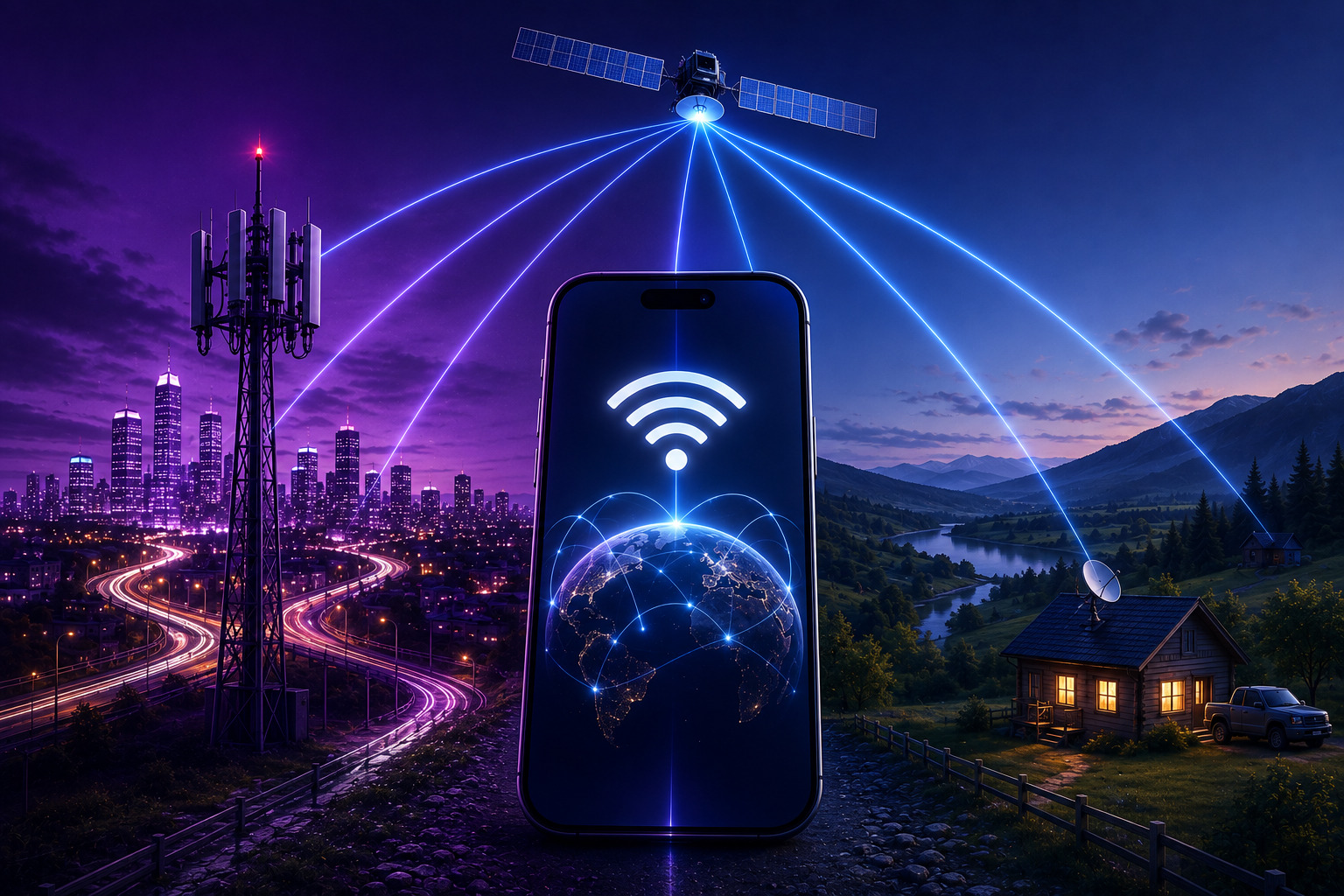
This hybrid model could become the most important consequence of Starlink Mobile 2026.
Imagine a smartphone connected to a conventional 5G network while you are in a city. As you drive into an area without towers, the phone transitions to satellite connectivity. When terrestrial coverage returns, it switches back.
The user does not necessarily need to manage that process manually.
Elements of this experience already exist. T-Mobile says T-Satellite automatically connects eligible devices when ordinary cellular service is unavailable, while Starlink’s longer-term V2 vision involves seamless transitions between high-capacity terrestrial 5G networks and satellite connectivity. (T-Mobile)
This could change how mobile operators think about coverage.
Historically, carriers have faced a difficult calculation when deciding whether to build infrastructure in sparsely populated regions. A tower may be technically possible but financially difficult to justify if only a small number of customers regularly use it.
Satellite coverage changes that equation.
Instead of trying to cover every last mile with terrestrial infrastructure, carriers could concentrate towers where capacity is needed most and rely increasingly on satellites for difficult coverage zones.
That could create networks that combine the density of terrestrial cellular infrastructure with the geographical reach of satellites.
What Increased Competition Could Mean for Consumers
Consumers should be cautious about assuming that Starlink will immediately trigger a dramatic wireless price war. The technology, regulatory environment and business models are still developing.
However, additional competition usually gives established providers another reason to improve their services.
Better Coverage
Coverage may be the clearest benefit.
Satellite-to-phone technology could reduce the number of places where a smartphone becomes completely disconnected. Rural roads, hiking areas, remote workplaces and regions affected by damaged infrastructure are obvious examples.
T-Mobile reported in May 2026 that T-Satellite had supported more than 250,000 users and carried over 1.5 million messages during Winter Storm Fern, illustrating the potential value of satellite connectivity when conventional infrastructure faces difficult conditions. (T-Mobile)
More Pricing Competition
Pricing could become another battleground if Starlink eventually offers its own SpaceX mobile service directly to consumers.
A new nationwide provider would need to convince users to switch from established carriers. Competitive pricing, flexible plans or bundled Starlink services could become potential ways to do that.
Nothing guarantees lower prices, of course. Building and operating both satellite and terrestrial infrastructure is expensive.
Still, another serious competitor could pressure the existing market.
Stronger Rural Connectivity
Rural users may have the most to gain.
Traditional mobile economics naturally favor densely populated areas because more subscribers can share each tower. Satellite networks reverse part of that equation by covering large geographical areas from orbit.
That does not mean every rural user will suddenly receive city-level 5G performance. Current satellite service still has limitations involving capacity, environmental conditions and supported applications. T-Mobile itself notes that satellite data behaves differently from conventional cellular data and that performance can vary. (T-Mobile)
But the difference between limited connectivity and no connectivity at all can be significant.
Greater Provider Choice
Perhaps the most interesting long-term effect is simply another option.
The US wireless market has consolidated around a small number of major network operators. If Starlink eventually becomes a genuine Starlink mobile carrier, consumers could gain another provider with a fundamentally different network architecture.
Even before that happens, satellite partnerships may allow existing operators to differentiate themselves through coverage.
As new types of mobile networks emerge, owning a device with fewer carrier restrictions could become even more valuable for consumers who want to take advantage of new connectivity options.
What This Could Eventually Mean for Device Compatibility and Unlocking
A changing network landscape also raises an important question: will today’s smartphones work seamlessly with tomorrow’s connectivity options?
The answer depends on more than whether a phone has 5G.
Device compatibility can involve supported frequencies, modem capabilities, software, carrier certification, eSIM configuration and the specific satellite technology used by a provider.
Today’s Starlink-powered T-Satellite already demonstrates this. T-Mobile says most smartphones from roughly the last four years can work with the service, but device eligibility and optimization still matter. (T-Mobile)
Carrier locking creates another layer.
An unlocked device does not automatically become compatible with every satellite or terrestrial network. Unlocking and technical compatibility are separate issues. A phone must still support the frequencies and network technologies required by the destination provider.
However, removing an eligible device’s carrier restriction can make switching between compatible providers much easier.
That distinction may become increasingly important if consumers eventually choose among traditional networks, satellite-enhanced carriers, eSIM providers and hybrid mobile services.
For someone buying a phone today and planning to keep it for several years, long-term network flexibility deserves consideration alongside the camera, processor and battery.
Conclusion: Competition May Be the Real Starlink Mobile Story
The biggest question surrounding Starlink Mobile 2026 is not whether satellites will suddenly make conventional cell towers obsolete.
That outcome looks unlikely.
The more realistic—and potentially more transformative—scenario is convergence.
SpaceX is developing more capable direct-to-phone satellites, expanding its spectrum position and considering a broader mobile strategy. Meanwhile, traditional carriers already recognize satellite connectivity as a practical way to extend their networks beyond conventional coverage areas. (SpaceX Content)
Over time, the distinction between “satellite service” and “mobile service” may therefore become much less obvious to consumers.
Your phone could connect to whichever network layer makes the most sense at that moment: a nearby terrestrial tower when capacity is available, a satellite when conventional coverage disappears, or potentially a combination of both within a broader hybrid network.
For consumers, that could mean fewer dead zones, stronger rural connectivity, new service options and greater competitive pressure across the US wireless market.
It could also make device flexibility increasingly valuable. As networks evolve, users may benefit from smartphones that can move between compatible providers without unnecessary carrier restrictions.
UnlockBase.com follows the evolution of mobile networks closely, helping users maintain device flexibility as the ways we connect continue to change.
All products, and company names, logos, and service marks (collectively the "Trademarks") displayed are registered® and/or unregistered trademarks™ of their respective owners. The authors of this web site are not sponsored by or affiliated with any of the third-party trade mark or third-party registered trade mark owners, and make no representations about them, their owners, their products or services.


Comments are closed.